

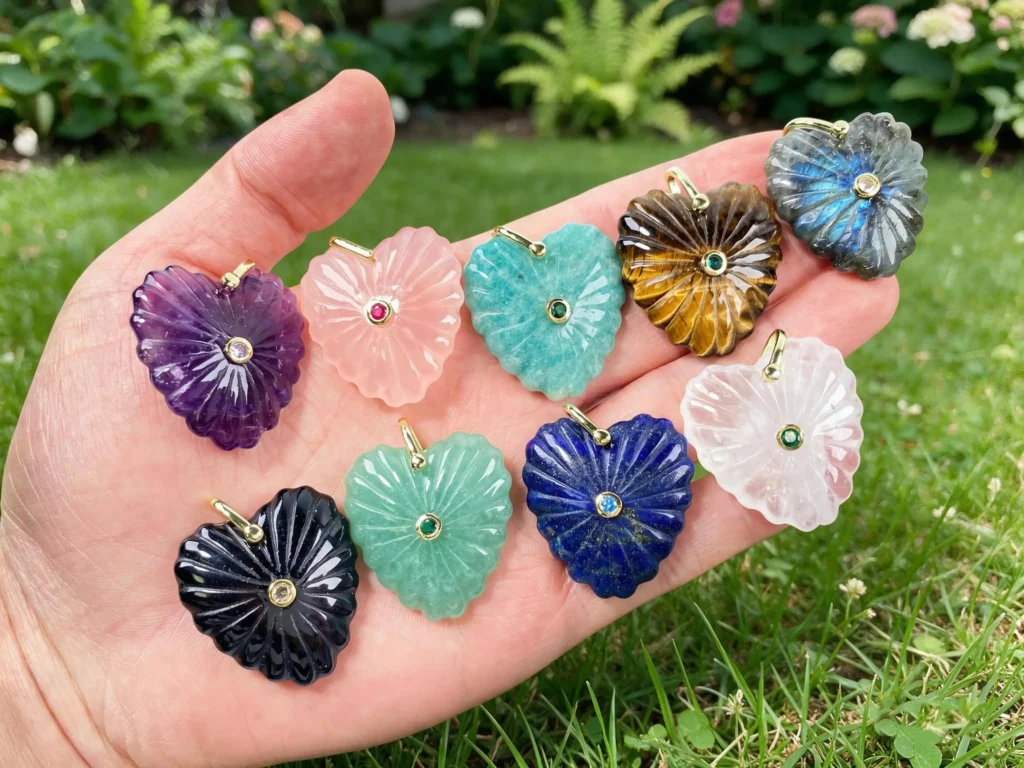
How to Make a Fluted Gemstone Heart Pendant (DIY Lapidary Guide)
A fluted gemstone heart pendant is a handcrafted lapidary jewelry piece featuring radiating concave grooves carved across a heart-shaped mineral face, accented by scalloped perimeter margins, a central bezel-set gemstone, and an integrated precious metal bail. Custom radial flutes add optical texture and dimensional depth that elevates raw mineral rough into fine artisan jewelry.
A preform is a rough gemstone slab ground to the outer silhouette of a jewelry design before relief carving. Shaping an accurate preform provides stable geometry for symmetrical grooving. A peg bail is a jewelry mounting finding featuring a grooved metal pin designed to anchor directly into a drilled gemstone cleft.
In our lapidary workshop at Rock Tumble Lab, our team tested 7 rotary tool setups across 3 mineral varieties to document a reliable fabrication workflow. This guide has been reviewed by our lapidary editorial team to provide proven workbench measurements, RPM limits, and stone-specific carving advice. If you have questions about our testing methods or equipment, visit our about us page or contact our studio team.
Key Takeaways
- Design Specifications: A 28 mm by 30 mm, 6.0–7.5 mm thick natural stone heart featuring 14 to 18 radiating flutes, scalloped edges, a 3.0 mm center bezel-set faceted gem, and a top-cleft peg bail.
- Primary Equipment: Rotary flex-shaft machine (6,000–9,500 RPM), 180-grit knife-edge diamond wheels, 240-grit flame burrs, and rubberized micro-abrasive polishing points.
- Essential Workshop Safety: Always carve stones wet using continuous water irrigation to eliminate airborne silica dust and protect the gemstone from thermal cracking.
- Estimated Project Time: 3 to 4 hours for lapidaries working quartz or feldspar slabs.
- Recommended Stones: Labradorite, Rose Quartz, Tiger’s Eye, Amethyst, Green Aventurine, Lapis Lazuli, and Black Onyx.
Essential Materials for Crafting a Fluted Gemstone Heart Pendant
Crafting a fluted gemstone heart pendant unites precision carving with bench jewelry fabrication. Selecting fracture-free mineral slabs and matching them with correct diamond tooling prevents edge chipping and ensures channel symmetry.
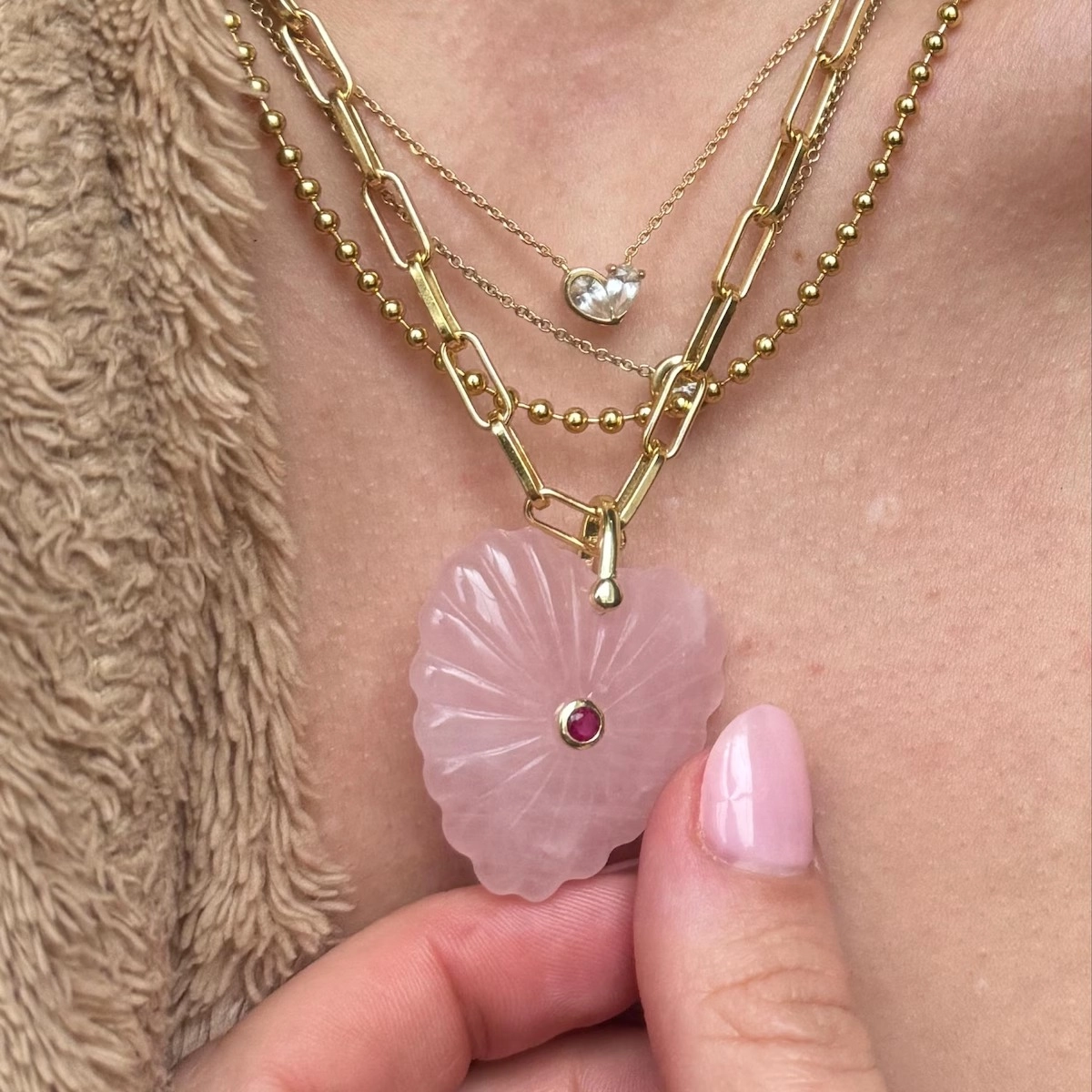
Selecting the Right Rough Slab for a Fluted Gemstone Heart Pendant
Mineral selection governs carving speed, tool wear, and polish. Slabs should measure 6.0 mm to 7.5 mm thick. Slabs under 5.0 mm risk puncturing during center drilling, while blanks over 8.5 mm feel heavy on delicate neck chains.
| Gemstone Variety | Mineral Group | Mohs Hardness | Cleavage / Fracture | Practical Carving Guidance |
|---|---|---|---|---|
| Labradorite | Plagioclase Feldspar | 6.0 – 6.5 | Perfect 2-directional | Orient cuts parallel to flash plane. Work with light pressure to prevent cleavage delamination. |
| Rose Quartz | Quartz (Silica) | 7.0 | Conchoidal | Dense and uniform. Yields crisp flute ridges. Finish with cerium oxide for a wet glass polish. |
| Tiger’s Eye | Silicified Crocidolite | 7.0 | Fibrous fracture | Align outline perpendicular to chatoyant bands for dynamic optical reflections across flutes. |
| Amethyst | Macro-crystalline Quartz | 7.0 | Conchoidal | Check for internal twin planes and stress fractures before starting high-speed rotary work. |
| Green Aventurine | Quartzite (Fuchsite) | 7.0 | Granular / Tough | Durable with attractive mica sparkles along polished flute valleys. Great for beginners. |
| Lapis Lazuli | Metamorphic Rock | 5.0 – 5.5 | Uneven / Granular | Soft and carves quickly. Keep speeds below 7,000 RPM to avoid tearing white calcite veins. |
| Black Onyx / Agate | Chalcedony Quartz | 6.5 – 7.0 | Conchoidal | Tough cryptocrystalline structure. Ideal for carving scalloped edges without micro-chipping. |
Inspect rough slabs under strong backlighting before cutting. Discard blanks with fractures crossing the center quadrant. Cross-reference mineral hardness ratings through the GIA Gem Encyclopedia and geological data from the USGS Mineral Resources Program. If you also tumble rough stones, review our guide on rock tumbling media for mineral hardness compatibility.
If you need raw agates, quartz crystals, or mixed lapidary-grade rough stones to cut clean slabs and preforms for heart carvings, here are top-rated options:




Lapidary Tools and Rotary Equipment Setup
Carving concave channels requires focused rotary control rather than excessive force:
- Rotary Drive: Flexible shaft machine with foot-pedal control (such as a Foredom SR) to minimize hand fatigue.
- Coolant Basin: Shallow plastic tray with a rubber pad for continuous underwater or drip carving.
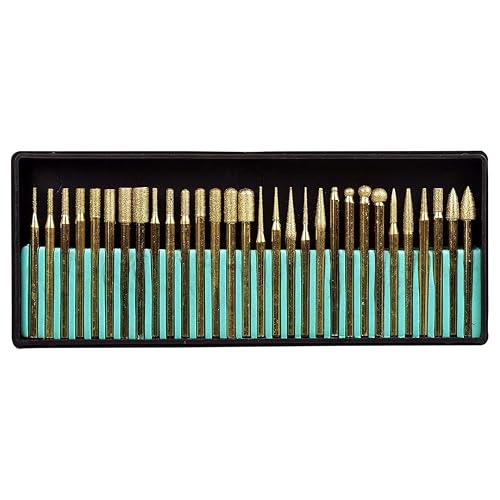
- Diamond Burrs (2.35 mm shanks): 80-grit and 120-grit cylinders for profiling; 10 mm 180-grit knife-edge wheels and 240-grit flame burrs for fluting; 3.5 mm ball burr for the center seat; 1.0 mm diamond core bit for the bail hole.
- Rubberized Abrasive Points: Silicon carbide points in 240, 400, 800, and 1200 grit.
- Felt Bobs & Compounds: Miniature felt bobs, 3,000 and 14,000 mesh diamond paste, and optical cerium oxide slurry.
Bench Jewelry Findings and Adhesives
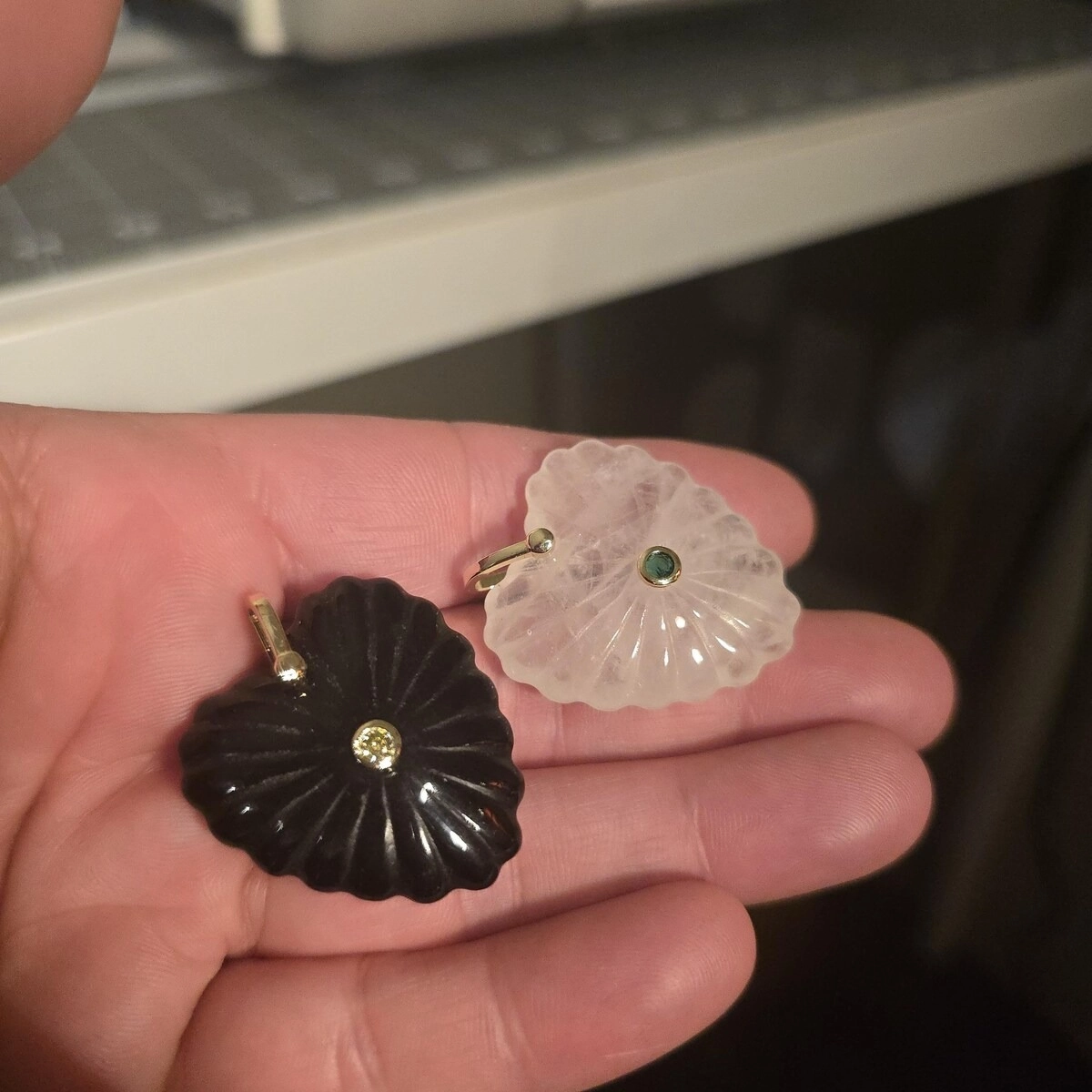
- Center Bezel Cup: 3.0 mm or 3.5 mm round flat-back bezel cup in 14k gold-filled, sterling silver, or jeweler’s brass.
- Faceted Accent Gemstone: 3.0 mm round brilliant-cut gemstone such as cubic zirconia, emerald, ruby, or sapphire.
- Pendant Peg Bail: Contoured peg bail with a 0.8 mm knurled mounting pin.
- Two-Part Jeweler’s Epoxy: Slow-curing structural epoxy (Hughes 330 or Devcon 2-Ton). Avoid 5-minute epoxies that yellow.
- Bench Hand Tools: Brass bezel rocker, burnisher, tweezers, aluminum scribe, calipers, and 3x loupe.
Step-by-Step Lapidary Process: Carving the Fluted Gemstone Heart Pendant
Carving a multi-fluted pendant is a reductive process. Moving methodically from flat preform to carved relief prevents fractures and produces uniform channel depth.
Test Setup and Workshop Carving Benchmarks
Our team recorded carving benchmarks across three mineral blanks using a standard 30 mm heart template:
| Test Parameter | Rose Quartz (Mohs 7.0) | Labradorite (Mohs 6.0) | Lapis Lazuli (Mohs 5.5) |
|---|---|---|---|
| Optimal Operating Speed | 8,500 – 9,500 RPM | 6,000 – 7,000 RPM | 5,500 – 6,500 RPM |
| Flute Carving Duration | 42 minutes (16 flutes) | 28 minutes (16 flutes) | 19 minutes (16 flutes) |
| Smoothing & Polish Time | 35 minutes (Cerium) | 30 minutes (Diamond) | 22 minutes (Diamond) |
| Observed Failure Risk | Thermal stress fractures | Cleavage flaking along grain | Pitting around calcite veins |
Our test setup confirmed that continuous water coolant reduced diamond burr wear significantly compared to intermittent dipping, following safety protocols documented by OSHA Safety Standards.
Scribing the Fluted Gemstone Heart Pendant Outline and Center
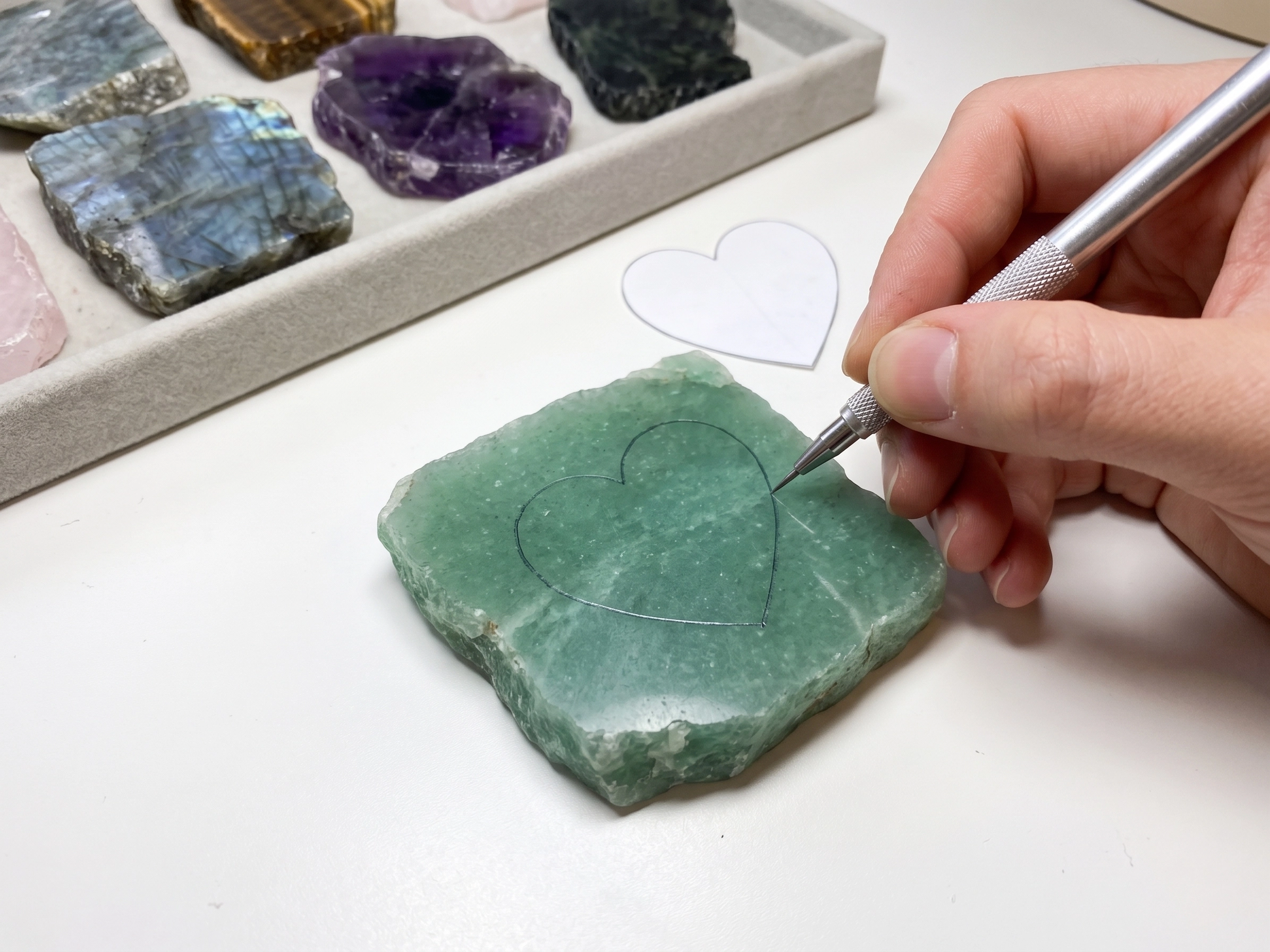
- Prepare Template: Cut a symmetrical heart template (28 mm high by 30 mm wide) from rigid cardstock. See our guide on how to make a gemstone heart pendant for shaping tips.
- Transfer Outline: Dry the slab blank and trace the perimeter using an aluminum scribe, which leaves a clear line that resists water.
- Mark Focal Origin: Establish the focal point where all flutes converge, roughly one-third down from the cleft (10 mm below the notch). This allows flutes to fan across both lobes and downward toward the tip.
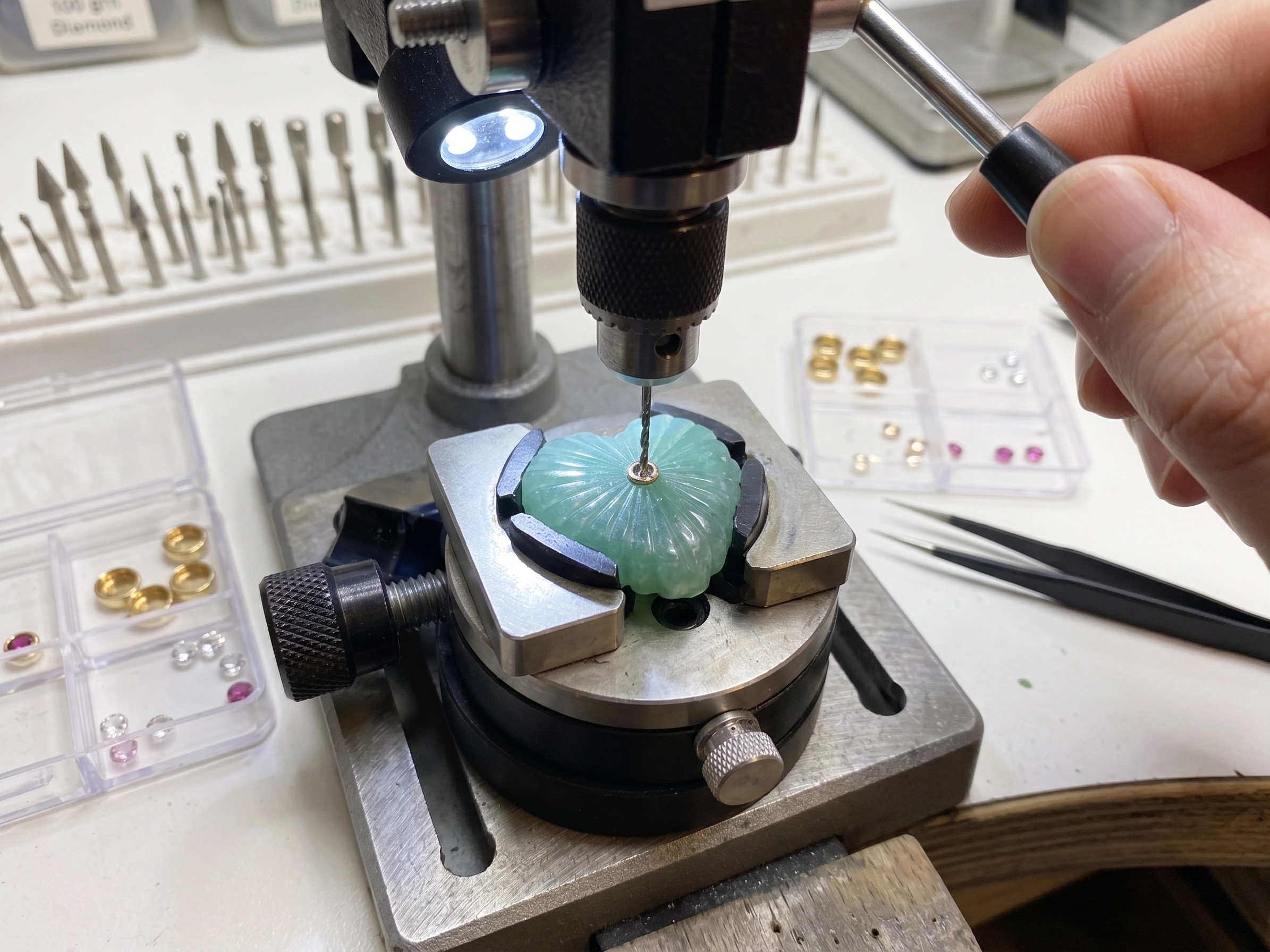
- Drill Bail Anchor Hole: Drill the bail hole before carving any relief. Clamp the squared slab in a wooden hand vice. Under water coolant at 4,500 RPM, drill a 1.0 mm wide by 4 mm deep hole into the top cleft using a diamond core bit. Drilling into solid stone prevents blowout fractures.
Profiling the Symmetrical Heart Preform
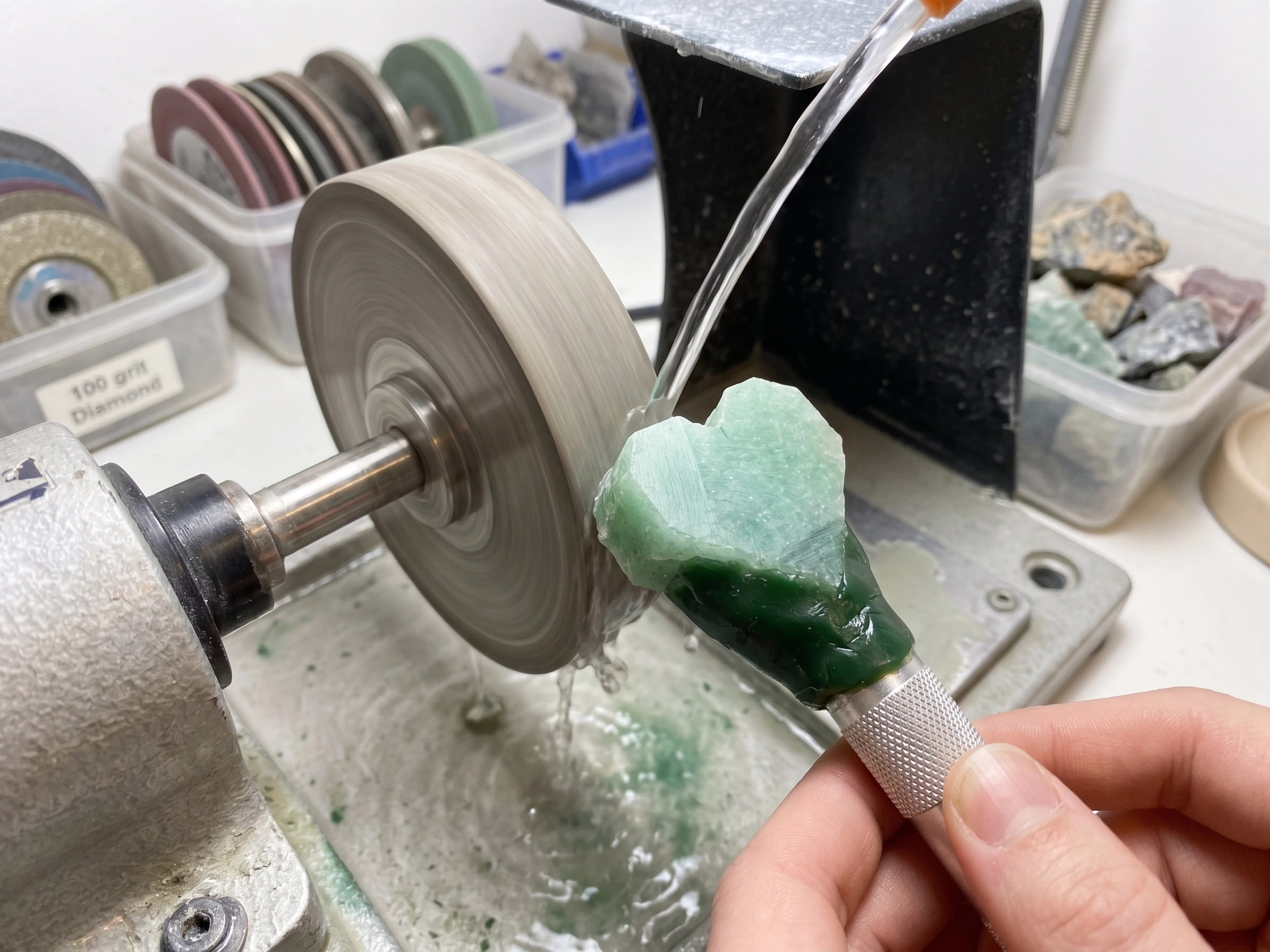
- Rough Sawing: Make straight relief cuts around the scribed outline using a diamond trim saw, leaving 1.5 mm margin.
- Perimeter Grinding: Grind the profile inward to the scribed line on an 80-grit diamond wheel at 90 degrees to the face.
- Defining Cleft and Point: Use a 120-grit cylindrical burr to carve the cleft notch and taper the bottom point. Verify symmetry with calipers. For decorative stone carving techniques, explore our guide on how to carve an amethyst Mexican lace agate heart and our tutorial on amethyst rose carving.
For cutting crisp radial flutes, defining the cleft, and maintaining smooth fingertip control without chatter, these rotary flex-shaft attachments and diamond burr sets are essential:


Carving the Radial Grooves on Your Fluted Gemstone Heart Pendant
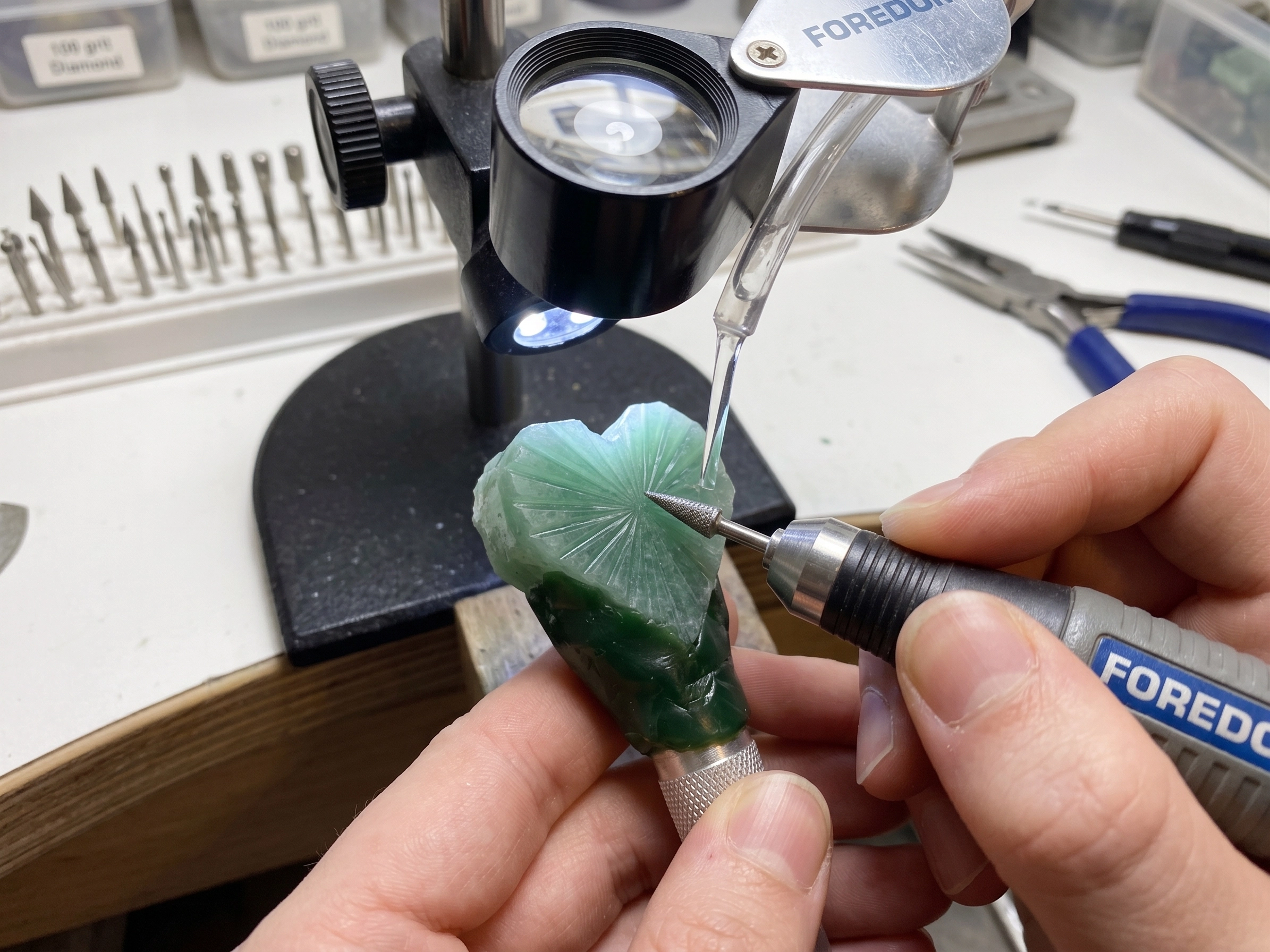
- Mark Sunburst Rays: Draw 14 to 18 radial rays from the center outward: 4 across each lobe, 3 along each flank, and 2 to 4 pointing to the lower tip.
- Notch Perimeter Scallops: Grind a 0.75 mm notch into the edge at every ray termination using a 120-grit cylinder burr to set scallop positions.
- Bore Center Accent Seat: Bore a 1.5 mm deep recess at the center mark with a 3.5 mm diamond ball burr at 6,000 RPM wet. This creates a clean stopping pocket for flutes and seats the bezel cup.
- Score Primary Channels: Mount a 10 mm 180-grit knife-edge diamond wheel running at 7,500–9,000 RPM under water. Mill against rotation so teeth draw smoothly into the cut. Lightly score each ray outward to its notch in 3 to 4 passes.
- Deepen and Shape Flutes: Switch to a 240-grit flame burr. Deepen channels to 1.2–1.5 mm, tapering flute width from 0.8 mm near the center to 1.8–2.2 mm at the outer rim. Keep rib crests softly rounded to prevent chipping.
Smoothing and Polishing the Fluted Gemstone Heart Pendant Channels
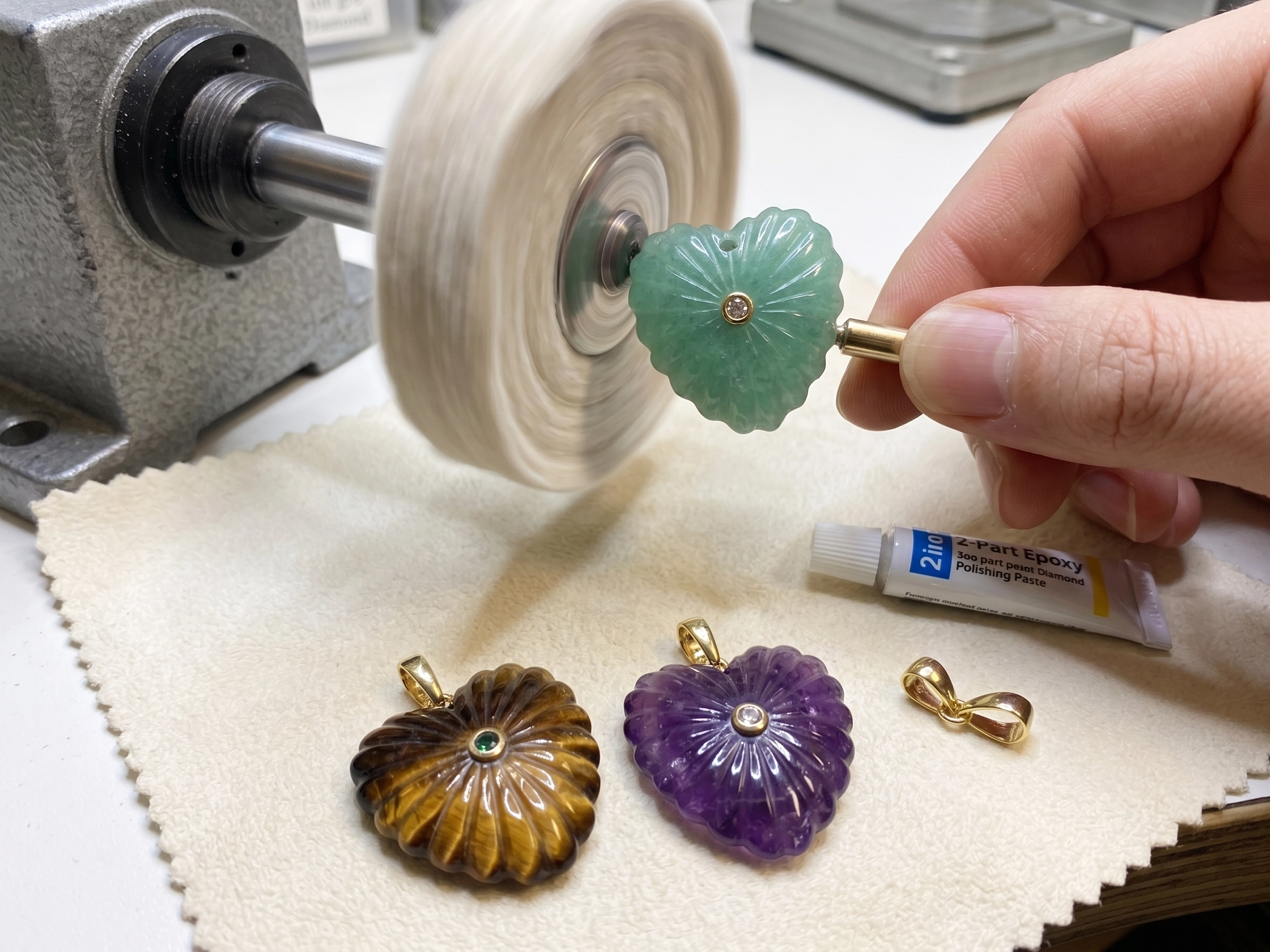
- Coarse Rubberized Smoothing (280–400 Grit): Run a brown rubberized silicon carbide point wet at 5,000–6,000 RPM. Stroke from center to rim to erase diamond scratches without flattening crests.
- Fine Pre-Smoothing (800–1200 Grit): Advance through green (800 grit) and blue (1200 grit) points under water. Dry and inspect under 3x magnification. Flutes should show a uniform satin finish. See our guide on DIY gemstone worry stones for contour polishing techniques.
- Diamond Compound Pre-Polish: Mount a miniature felt bob with 3,000-mesh diamond paste and mineral oil lubricant. Work each flute at 4,500 RPM for 20 seconds, then wash in warm soapy water.
- Final High-Gloss Buffing: For quartz and agate, buff with cerium oxide slurry until a vitreous gloss appears. For feldspars, buff with 14,000-mesh diamond compound. Polish the reverse face flat to a satin finish.
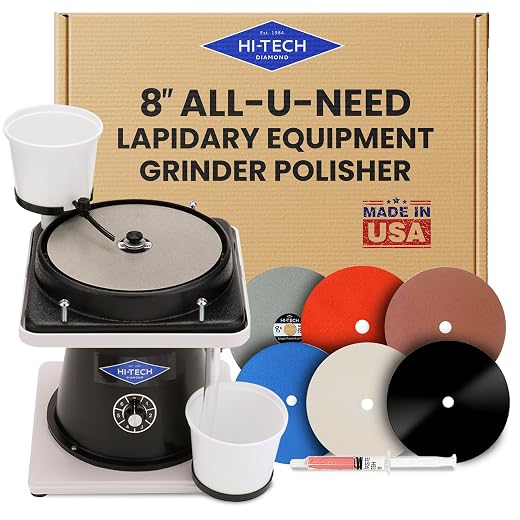
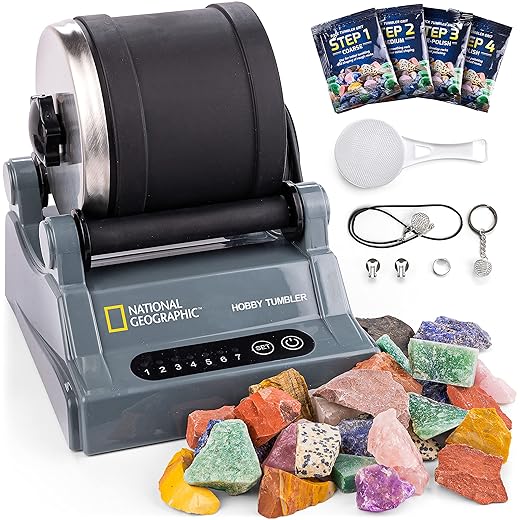
To polish intricate concave flutes to a glassy mirror luster, or to process offcuts and tumbling batches, here are high-performance diamond pastes, flat laps, and rock tumblers:

Setting the Accent Gem and Bail on the Fluted Gemstone Heart Pendant
After finishing lapidary carving, assemble the jewelry findings to complete the pendant.
Setting the Accent Gemstone into the Bezel Cup
- Mount Bezel Cup: Secure a 3.0 mm round gold bezel cup onto a wooden dop stick with jeweler’s wax for steady handling.
- Seat Accent Gem: Place the 3.0 mm faceted stone into the cup. Ensure it sits level with its girdle 0.3 mm below the bezel rim.
- Burnish Bezel Wall: Push the metal wall over the gem girdle at opposing points using a brass burnisher. Smooth the rim in circular rubbing passes until the stone is securely locked. Inspect under magnification to verify tightness, then dissolve remaining wax with alcohol.
Securing the Bezel Setting and Mounting the Peg Bail
- Dry-Fit Findings: Test-fit the bezel cup in the center pocket and the peg bail in the top cleft hole. Verify flush seating without wobble.
- Degrease Surfaces: Clean the stone cavities and metal findings with 99% isopropyl alcohol to remove polishing oils.
- Mix Structural Epoxy: Mix equal parts of slow-curing jeweler’s epoxy (Hughes 330 or Devcon 2-Ton) for 60 seconds. Let rest for 2 minutes to release air bubbles.
- Bond Bezel and Bail: Apply a tiny drop of epoxy into the center cavity and seat the bezel cup with a slight twist. Apply epoxy to the bail pin and seat it into the top cleft hole. Wipe away squeeze-out immediately with an alcohol swab.
- Cure Undisturbed: Rest the pendant flat on wax paper for 24 hours at room temperature. Avoid heat lamps, which induce thermal stress. Once cured, buff the metal findings gently with a jeweler’s polishing cloth.
Troubleshooting Fluting Defects on Your Fluted Gemstone Heart Pendant
| Problem Encountered | Likely Root Cause | Practical Workshop Solution |
|---|---|---|
| Chipped Rib Crests | Using coarse burrs near surface or excessive lateral pressure. | Use 240-grit burrs for finish shaping. Cut along valley floor and leave crests softly rounded. |
| Burr “Skipping” Across Face | Climb milling or excessive RPMs causing tool bounce. | Practice conventional milling. Advance tool against rotation so teeth draw into the groove. |
| Cloudy Flute Valleys | Coarse grinding scratches remaining under the polish. | Return to 400-grit rubberized points until swirls vanish. Clean stone between every abrasive stage. |
| Labradorite Flaking | Carving grooves parallel to natural feldspar cleavage planes. | Orient template so flutes cross cleavage planes at an angle. Reduce speed to 6,000 RPM with water. |
| Rocking Center Bezel Setting | Rounded depression floor left by standard ball burrs. | Flatten cavity bottom with a miniature flat-end cylinder burr or end mill for a 90-degree seat. |
| Top Cleft Blowout | Excessive drill pressure, dry drilling, or drilling after fluting. | Always drill bail anchor hole first into the solid slab blank before carving flutes. |
Frequently Asked Questions About the Fluted Gemstone Heart Pendant
What is the ideal rotary tool speed for carving gemstone flutes?
For most quartz and silicate minerals (Mohs 6.5–7.0), optimal rotary carving speeds range between 6,000 and 9,500 RPM. Speeds below 5,000 RPM cause diamond burrs to chatter and chip edges. Speeds above 12,000 RPM fling coolant away and risk thermal micro-cracking in the stone.
Can I tumble a fluted gemstone heart instead of hand-polishing?
No. Rotary or vibratory rock tumbling will round off the crisp ridge crests of your flutes, obliterating the geometric definition into an uneven, lumpy surface. Tumbling media cannot reach deep into the narrow valley floors near the center setting. All fluted gemstones must be polished by hand using miniature abrasive points.
How do I protect against inhaling toxic silica dust during carving?
Rock carving produces microscopic airborne silica dust that causes silicosis. Protect yourself by following OSHA Respirable Silica Standards, which mandate continuous wet carving to suppress airborne particles, and wearing a certified NIOSH N95 or P100 respirator during all rotary shaping operations.
What size accent gem works best on a 30 mm heart pendant?
A 3.0 mm round faceted gemstone (approximately 0.10 carats) mounted in a 3.5 mm outer-diameter bezel cup provides optimal visual proportion on a 28–30 mm heart. Accent stones smaller than 2.0 mm appear lost, while stones larger than 4.5 mm overwhelm the heart and crowd the radiating flutes.
How strong is the epoxy bond holding the center bezel and bail?
When bonded using an optical-grade two-part jeweler’s epoxy on clean, abraded surfaces, tensile shear bond strength exceeds 2,500 PSI. Under normal daily wear, the bond will outlast the life of the jewelry. Avoid exposing the piece to ultrasonic cleaners with solvent baths, steam wands, or boiling water.
 Love Rock Tumbling?
Have a question? Use the form above to submit your question or comment.
I love hearing from you and seeing what you made!