

Rocky Lake Superior beaches in Michigan’s Upper Peninsula are the best place to start looking for agates. What looks like an ordinary pebble from a few steps away may hold delicate bands inside. The western UP and Keweenaw offer a strong starting point, but finding a good stone takes patient scanning, not luck alone.
Timing, identification, and local rules all shape a successful outing. You can make a first trip worthwhile even if your bag stays nearly empty: each stretch of shoreline teaches you what the gravel looks like and how it changes.
Plan for a slow walk, a safe route, and time to look at individual rocks. The Great Lakes shore can be generous with interesting material, but no beach guarantees an agate. Treat a first outing as a chance to learn the shoreline, not a promise to fill a bag.
How Lake Superior Agates Form
A Lake Superior agate begins as silica-rich water filling a gas-bubble cavity in lava. A vesicle is a hollow gas-bubble cavity left in cooled lava. Silica fills the cavity in layers, forming the agate’s bands.
As lava cooled, gas bubbles left open spaces in the rock. Later, silica-rich solutions moved through those cavities and deposited minerals in successive layers. Differences in the minerals and conditions created the colors and patterns that make each rock distinct.
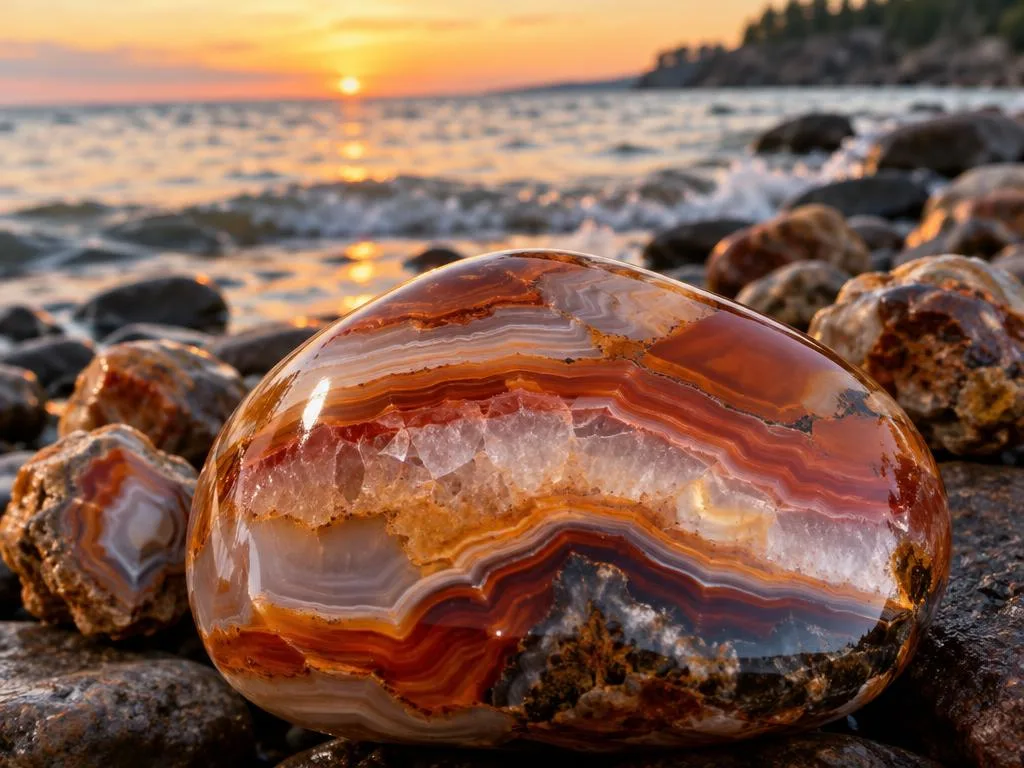
Silica fills gas-bubble cavities in lava
Lake Superior agates are mainly chalcedony, a variety of quartz. Chalcedony forms when silica-rich solutions harden inside vesicles. As the deposits build, thin mineral layers create banding that may curve around the cavity’s original shape.
Not every cavity becomes an agate, and not every agate develops the same visible pattern. Iron-bearing minerals can contribute warm red, orange, and brown colors. Other minerals and the way the layers formed affect a stone’s appearance.
Glaciers and waves expose the stones
Agates found along the Great Lakes have a long journey behind them. The Laurentide Ice Sheet began growing as temperatures cooled approximately 30,000 years ago. It carried rocks from Canada into Michigan, then left them behind as glacial erratics when the ice retreated.
Those transported rocks became part of glacial deposits, including moraines: ridges and piles of material left by glaciers. Regional glacial deposits helped shape Michigan’s landscape, as described in the Geology of Michigan and the Great Lakes textbook.
Along the Lake Superior shoreline, erosion works on those deposits over time. Wave action can sort and move the loose rock, while softer material washes away. Waves can remove the moraine’s softer soil and leave its stones exposed on the beach.
Where to Find Agates in Michigan
For the western UP, start with the rounded-rock beach at Little Girl’s Point near Ironwood; for an easy Grand Marais stop, head north from the town’s main street toward the lake. Rocky Lake Superior beaches across the Upper Peninsula are the most practical places to search.
Michigan agates are reported at beaches from the western Upper Peninsula to the Keweenaw and eastern shore. The rounded gravel at Little Girl’s Point is a good place to practice looking through varied beach rocks.
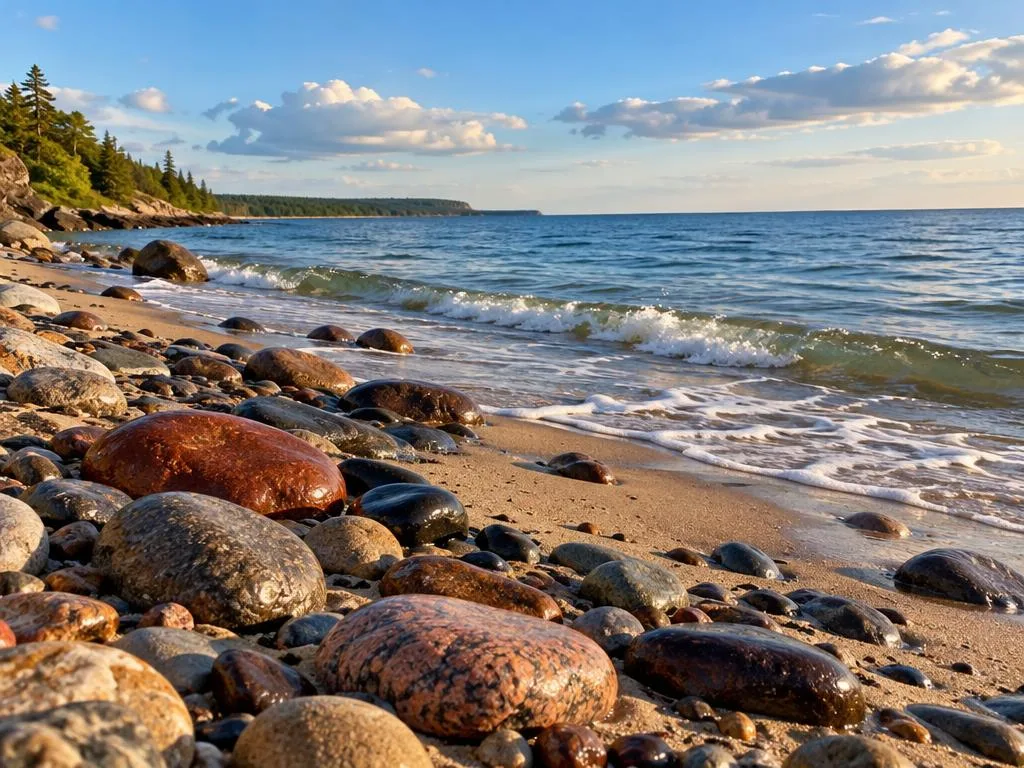
Western UP and Keweenaw beaches
Little Girl’s Point, near Ironwood, has a beach covered with rounded rocks rolled ashore by Lake Superior waves. The range of sizes and colors makes it an inviting place to scan slowly. Crisp Point, near Paradise, is another reported spot for Lake Superior agates.
In the Keweenaw, McLain State Park has two miles of Lake Superior shoreline. Calumet Waterworks Park, Great Sand Bay, and Esrey Park are other area options for rockhounding. Each stretch offers its own mix of shoreline, access points, and stones.
Grand Marais and the eastern shore
Grand Marais Agate Beach is a Burt Township park beside Woodland Park Campground. From the town’s main street, head north toward the lake. Donahey Woods beach access sits at the west end of Woodland Park Campground, where a trail leads down to the beach.
Perry’s Landing is approximately 12.5 miles east of Grand Marais on H-58. It offers another shoreline stop for a day of looking. Grand Marais Agate Beach is in the township; nearby Pictured Rocks National Lakeshore has different collecting rules.
Agate Beach Park campground at 42870 Agate Beach Road in Toivola is 25 miles southwest of Houghton. It is open from Memorial Day through Labor Day and has 25 tent campsites, rustic toilets, picnic tables, and a beach for swimming or paddling. There are no electrical hookups, and you do not need to camp to visit other beaches.
A west-to-east beach route
A Lake Superior rock-hunting map can help you plot a west-to-east route before leaving. For a simple sequence, mark Little Girl’s Point, the Keweenaw shoreline options, Grand Marais, and Perry’s Landing. Choose stops based on access and the time you have, rather than trying to cover every mile.
Grand Marais is a useful base for beach visits, and Agate Beach is easy to reach from town. Its boardwalk gives visitors a view across the lake. At Grand Marais, the boardwalk added in summer 2005 offers a lake view, while beach access remains the reason to bring a rock bag.
Plan your beach search: These field references help compare Michigan stones and record where you searched; check current access rules before collecting.




Michigan’s Rock Collecting Rules and Boundaries
On Michigan state-owned and public-trust land, one person may collect up to 25 pounds of rocks per year in total. The 25-pound annual limit applies across beaches, not separately at each one. Check with the land manager and read posted signs before you collect.
The annual amount is cumulative, so a full bucket from one visit does not create a new allowance elsewhere. Michigan’s 25-pound annual collecting limit covers rocks collected by one person from state-owned and public-trust land.
Where the 25-pound annual limit applies
Public-trust shoreline collecting applies below the ordinary high-water mark. In plain language, that mark is usually within a few vertical feet, and sometimes only inches, of the current water level. It virtually never reaches the top of a beach.
That boundary matters because a public beach can meet land with a different owner or manager. A public-trust shoreline does not mean every nearby rock is free to take. On private land, get permission from the owner before collecting anything.
Protected shores and local restrictions
Collecting beach stones is prohibited within national parks and national lakeshores, including Pictured Rocks National Lakeshore. Its boundary lies just west of Grand Marais, and Sable Falls beach below the Grand Sable Dunes is inside the lakeshore.
Grand Marais township beach collecting is allowed within the 25-pound annual limit, but collecting in Pictured Rocks National Lakeshore is prohibited. That difference makes the boundary especially important when visiting the area. Do not assume two nearby beaches share the same rules.
The Whitefish Point Unit of Seney National Wildlife Refuge prohibits rock collecting and is open only during daylight hours. Municipal parks and beaches may also restrict collecting through local rules or posted signs. Signs and boundaries matter even when a beach looks open to everyone.
Some land managers set rules beyond the statewide limit, so check the exact location before pocketing a find. If a boundary or local sign leaves the rules unclear, leave the stone where it is and check with the land manager.
The Best Time to Search Lake Superior Beaches
A sunny search after strong winds or a storm can reveal freshly rolled stones along a Lake Superior beach. Wait until the storm has passed and the shoreline is safe before searching. Fresh gravel can bring new rocks into view, giving you a changed surface to scan.
Wind and waves shift beach material, sometimes rolling a new crop of stones ashore. This does not guarantee an agate, but it can make the search more promising than revisiting unchanged gravel. The beach may look different after a period of strong weather.
Fresh gravel after wind and waves
Look for areas where the gravel has visibly shifted or gathered in new bands along the shore. Freshly moved stones may have cleaner surfaces and different colors than the material you saw on an earlier visit. Take your time to compare patches instead of walking past them quickly.
Do not search during a storm, when waves are rough, or while conditions remain unsafe. A promising line of new stones is never worth stepping into dangerous water. Let the weather settle and choose a stable route along the beach.
Seasonal and weather conditions
Early spring and late fall can be useful seasons if you prefer quieter beaches. Fewer people may mean more time to look without feeling rushed. Dress for the day’s conditions and plan for the changing weather common along the Upper Peninsula shoreline.
Sunny conditions make surface color and luster easier to see. Direct sunlight can help you compare stones against the surrounding gravel, especially when colors appear muted in shade. A calm, bright day is a practical choice for close scanning.
Check the forecast and shoreline conditions before setting out, then reassess when you arrive. Waves and wind can change how safe a beach feels within a short time. Wait until waves and weather are safe before stepping onto the shoreline.
How to Identify a Lake Superior Agate
A dull, waxy red, orange, or brown stone with a pockmarked surface is worth a closer look. Color and texture can point you toward a candidate, but neither proves it is an agate. Check several clues together before deciding a rock is ordinary gravel.
Use this short checklist while scanning a beach:
- Color: Look for red, orange, or brown tones.
- Luster: Notice a dull or waxy surface.
- Texture: Check for small pockmarks or pits.
- Translucency: Hold the stone toward light to see if it passes through.
- Banding: Look for curved or layered lines.
- Heft: Compare its weight with similar-sized rocks.
Surface clues worth checking
Lake Superior agates can have a pockmarked surface and a dull, waxy luster. Some feel heavier than ordinary rocks of similar size because of their density. Relative heft is only one clue, so compare a candidate with nearby stones rather than relying on weight alone.
A rough exterior may conceal an agate inside. An unpolished stone can show no visible bands on its outside, even when colorful layers lie beneath the surface. Do not reject it too quickly just because the outside looks plain.
Test for banding and transmitted light
Wet stones can show their shine and banding more clearly. A small spray bottle is handy on dry sections of beach, where water is not already coating the rocks. The changing surface can make colors and details easier to notice.
Hold a candidate up to the sun or shine a flashlight through it. Some agates transmit light, especially at thinner edges. The light-transmission clue can help you assess a rough stone, though it is not a guarantee by itself.
Inspect the stone from more than one angle, since a band may be hidden by its shape or rough coating. Look for curved layers rather than expecting a neat stripe across the whole surface. A lack of visible exterior bands alone is not enough to rule out a promising rough stone.
Simple Gear and a Careful Search Method
A small bag and hand rake are enough to make a focused search more comfortable. Start with a few simple tools, then work one small patch of beach at a time. You do not need a large kit to inspect shoreline rocks carefully.
Pack only what helps you scan and carry a few finds. A light setup makes it easier to move along the beach without hauling extra material over uneven ground.
A small, useful beach kit
Useful options include:
- A small bag or bucket for carrying collected stones.
- A hand rake or trowel for shifting beach rocks gently.
- A 5-gallon bucket with plexiglass fixed to the bottom for viewing stones underwater.
A hand rake or trowel can help move rocks while you search. Use it gently so you can see what is underneath without scattering the beach material. The viewing bucket is optional, not a requirement for a productive walk.
Search one patch thoroughly
Choose a small patch of gravel and scan it carefully before moving a few feet. Look at stones in place, then check the next narrow strip. This steady pattern helps you notice details that disappear when you rush along the whole beach.
Waders are optional and only useful when the water, weather, and footing make them safe. Do not enter water just to reach a patch of stones. Comfort is secondary to a stable place to stand and a clear route back.
Keep your search focused on rocks you can inspect without digging deeply or disturbing the shoreline. Work only where footing and water conditions are safe, and leave the beach undisturbed beyond the stones you inspect.
A compact beach kit: A bright white flashlight, loupe and small bag support careful inspection and light packing on a rocky beach.


Yooperlites and Other Lake Superior Finds
A Yooperlite looks like an ordinary rock in daylight but glows under ultraviolet light after dark. A 365-nanometer UV flashlight reveals the glow in sodalite-rich syenite. Collecting is allowed only where local land rules permit, so check the location before taking a stone.
Glaciers carried Yooperlites from the Coldwell Alkaline Complex near Marathon, Ontario. The fluorescent mineral in the rock is sodalite. This separate nighttime find adds a different kind of search to a Lake Superior visit.
Spotting Yooperlites after dark
Use a 365-nanometer UV flashlight to scan the ground after dark. Wear UV-protective glasses while searching, and move slowly enough to distinguish rocks from sand and shadows. Choose a place where you can walk safely without stepping into water.
Only collect Yooperlites where the local land manager allows rock collecting. The fact that a stone glows does not change the rules for the beach or park. Follow the same location-specific restrictions that apply to other beach finds.
Recognizing other colorful beach finds
Keweenaw beaches can hold more than agates and fluorescent rocks. Possible finds include native copper, prehnite, quartz, and amethyst. The area’s minerals and rocks reflect a varied regional geology, so you may see several kinds of material in one stretch of gravel.
Other Keweenaw possibilities include datolite, thompsonite, jasper, rhyolite, and beach glass. Some pieces stand out by color; others take a closer look to recognize. Learning the names is useful, but you do not need to identify every stone to enjoy the search.
Carry a small notebook or take a mental note of where a distinctive rock appears, so you can compare similar material on another visit. Keep the UV beam directed at the ground and wear UV-protective glasses while searching.
Other Michigan Rockhounding Finds
Michigan’s other shorelines and inland gravel can turn up very different finds from Lake Superior agates. Lake Michigan beaches, inland deposits, and the northeastern Lower Peninsula each offer distinct rockhounding possibilities. Local geology shapes what appears in the gravel.
Lake Michigan stones and fossils differ by shoreline and local geology. A beach on one side of the state may offer different colors and material from a beach farther north or east. Glaciers left erratics across Michigan, including Lake Superior agates and Yooperlites.
Lake Michigan stones and fossils
Michigan rockhounds may find Petoskey stones, fossils, beach glass, copper-bearing rocks, and Lake Michigan separation nodules. Lightning stones are another possible find. These are different kinds of treasures, so learn what is common to the shoreline you plan to visit.
Puddingstones are quartzite conglomerates with red jasper inclusions. Their contrasting pebbles make them easy to notice when beach gravel is varied. The northeastern Lower Peninsula is a place to look for puddingstones along the shore.
There is no definitive ranking of the rarest Lake Michigan rocks. Unusual finds can include separation nodules, fossils, and lightning stones, but what appears depends on the beach and its geology. Keep expectations flexible when you explore a new area.
Puddingstones and inland gravel
Agates may also turn up in freshly graded roads and rock quarries. Newly exposed material can reveal stones that were hidden beneath the surface. A roadside or quarry find still depends on having permission to access and collect there.
Inland gravel can hold glacial erratics that differ from the rocks along a nearby shore. Look for changes in the material rather than expecting one recognizable type everywhere. A mix of colors and textures may be a clue that a gravel deposit has several origins.
Check land access before collecting from a road, quarry, farm field, or private property.
After the Find: Clean, Inspect, and Tumble
A rough stone that looks plain on the beach can reveal striking bands after tumbling. Cleaning and polishing may uncover color hidden beneath a rough exterior, but not every stone will polish well. Start by removing loose dirt and inspecting the rock in good light.
A Grand Marais find illustrates the surprise a rough exterior can hold. An EGLE geologist found a rusty-brown, pockmarked agate with no visible exterior bands. Tumbling revealed purple amethyst bands inside.
That result does not mean every brown or pitted stone will become a polished showpiece. Some rocks have fractures or shapes that do not hold up well in a tumbler. Choose a stone with realistic expectations and inspect it as the process goes on.
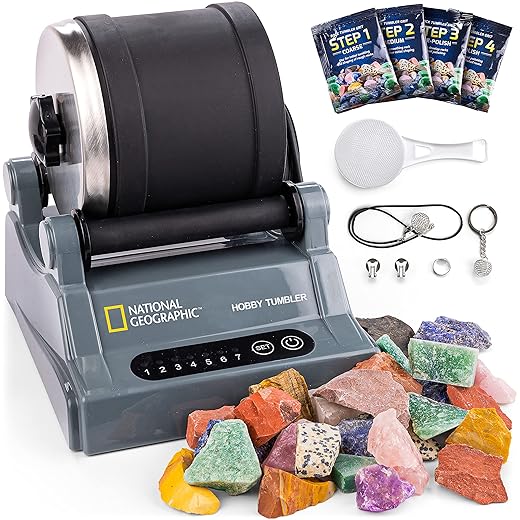
A typical rotary tumbler uses four stages: coarse grind, medium grind, pre-polish, and polish. Each stage changes the stone’s surface before the next step. Follow the tumbler’s instructions and make sure the rock suits the process.
Cleaning first can help you see the stone’s natural color and surface more clearly. Tumbling removes roughness gradually, so hidden bands may become easier to see as the outer layer wears down. Keep an eye on the stone as it tumbles, since a fractured or unsuitable piece may not hold its shape.
For a suitable agate batch: If you decide to tumble sound agates, match the barrel load and abrasive stages to your tumbler's instructions.


Conclusion
A good first agate hunt starts with a safe public beach and time to look closely. A patient search on a rocky Lake Superior shoreline gives you a practical way to learn what the gravel holds. Finding no agate on your first trip does not make the outing a failure.
Before leaving home, check beach access and current local signs for the place you plan to visit. Pack a small bag, check the beach rules, and give the shoreline a patient search.

 Love Rock Tumbling?

Have a question? Use the form above to submit your question or comment.
I love hearing from you and seeing what you made!